
Modern search is no longer centered on traditional search engine results pages (SERPs). Today, users can get answers directly from generative summaries and chatbots such as Google AI Overview, ChatGPT, Gemini, and Claude. These tools come with their own dynamics and have led to new optimization pathways that may confuse those unfamiliar with AI-driven search.
Understanding the mechanics of AI search optimization starts with clarity on various terms like LLMO, GAIO, GEO, and SGE.
What is AI Search Optimization?
Thirty-seven percent (37%) of users now start their search through AI tools rather than Google. Instead of scanning a list of blue links, AI tools allow users to get direct answers right away. AI search also addresses traditional search fatigue caused by clicking through so many links and encountering too many sponsored results. As a result of this behavior shift, new disciplines are emerging for how brands are being discovered.
AI search optimization is the process of making web content more visible across AI-powered search experiences. Instead of aiming for a higher SERP ranking, AI search optimization focuses on retrieval and citation for AI-generated answers.
Suppose a user wants to know the rules of pickleball before an impromptu game. Instead of going through various results in Google, they can get a quick, summarized answer in ChatGPT. In this scenario, the AI tool became a channel for discovery that brands can take advantage of.
If a marketing agency Philippines can prompt AI systems to cite a brand’s websites as a source or even get their name mentioned within the answer, it is an opportunity to gain visibility and familiarity. Effectively, AI search optimization shifts the goal from simply ranking on a page to being recognized and referenced wherever users obtain answers.
LLMO, GAIO, GEO, and SGE all fall under this broader framework. Each term represents a different angle of the same concept: optimizing content for search visibility in AI results.
What is LLMO?
Large Language Model Optimization (LLMO) is the method of becoming more visible in large language models (LLMs) like ChatGPT, Claude, and Gemini. LLMs refer to advanced AI systems that can process large data sets, allowing them to understand and generate texts in natural human language to perform a wide range of tasks.
LLMO involves establishing brand authority through:
- Information Gain: Produce exclusive knowledge that users will not find on other sites.
- Structured and Semantic Content: Implementing clear structure in web pages to improve readability for both humans and AI systems.
- Authority and Mentions: Ensure the brand is frequently mentioned in connection with certain subjects.
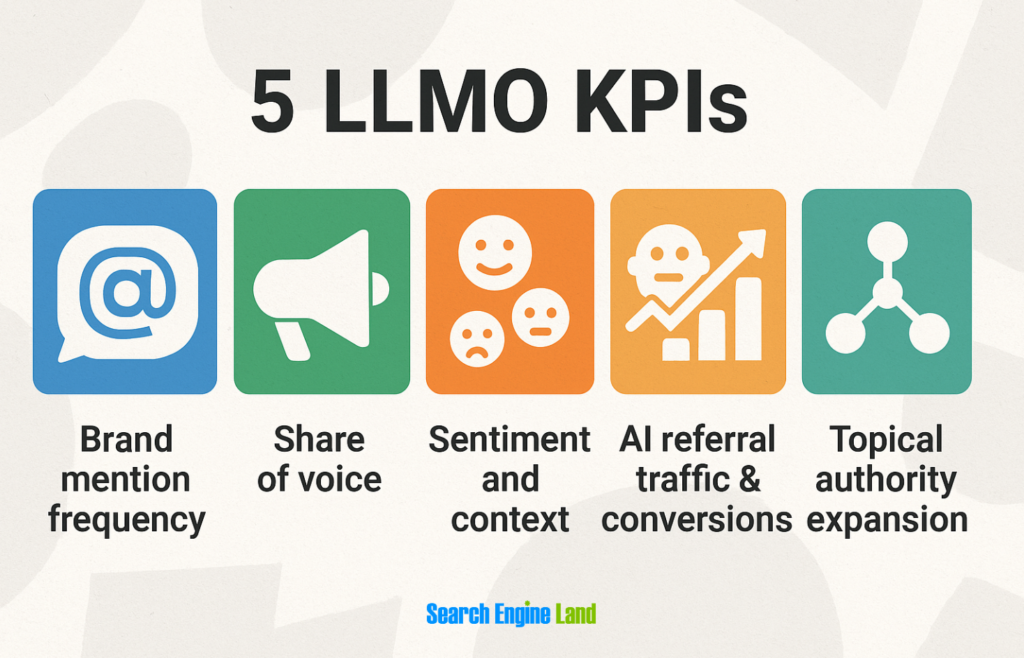
Image from Search Engine Land
What is GAIO?
Generative Artificial Intelligence Optimization (GAIO) aims to make content included or referenced in any generative AI response, whether from a chatbot, AI summaries, or AI assistants. It covers all forms of generative AI, including text, image, audio, video, and other media.
GAIO complements LLMO. While LLMO ensures AI models comprehend the brand’s content, GAIO ensures that the content is actually selected, cited, or referenced in AI-generated responses.
LLM Vs. Generative AI
LLMs and generative AI systems are closely related, but they serve different purposes. LLM’s focus is on interpreting and learning from large data sets to generate text outputs. Meanwhile, generative AI systems center on generating outputs for users, whether it is text or multimedia. While LLMs provide the underlying intelligence, generative AI applies that intelligence to deliver actionable answers or content in response to a user query.
What is a GEO?
Generative Engine Optimization (GEO) positions content specifically for AI channels that generate a response, like Google AI Overview, Perplexity, and Microsoft Copilot. Generative engines are systems that gather information from various sources across the web and synthesize it into a comprehensive answer. GEO targets aligning content with the retrieval methods of these specific generative engines.
For example, Google AI Overview can retrieve precise product details when generating a response for a query about pickleball paddle prices. To ensure Google can reliably display the brand, the company must optimize its product pages with up-to-date, accurate information.
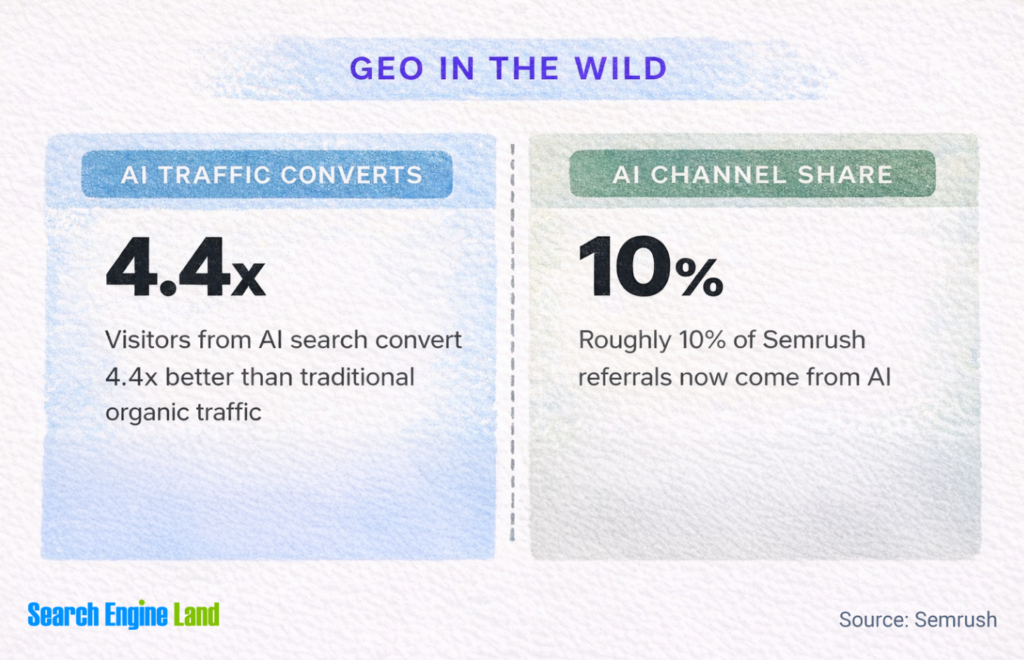
Image from Search Engine Land
SGE Reshapes Users’ Search Experience
While optimization efforts, LLMO, GAIO, and GEO, focus on content readiness, search generative experience (SGE) shifts that to the front-end search experience. SGE represents the practical application of AI search optimization within Google’s search ecosystem.
SGE began as an experimental generative search feature in Google Labs in 2023. In May 2024, the experience was rebranded as ‘AI Overviews’ and started rolling out to all users. In October 2025, Google launched its AI Mode globally, which is an extension of SGE and AI Overview. It can be accessed through the AI Mode tab at the top of the SERP and expands the user experience by enabling an interactive interface for in-depth, conversational search.
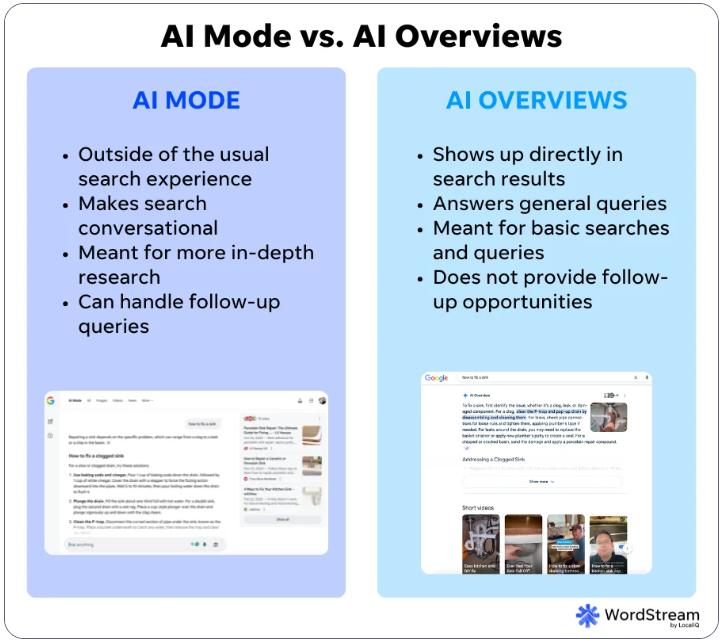
Image from WordStream
SGE uses generative AI to craft personalized results for a user. To do this, Google taps into models like PaLM 2 and Gemini to combine deep learning with user data (e.g., location, search history, preferences).
Suppose a user is looking for a pickleball paddle for beginners, Google’s AI Overview will present a fully unique SERP. At the top, the AI generates a concise summary of recommended paddles, highlighting key features, pros, and notable models. It also displays visual assets, such as product images or comparison graphics.
Below, it may embed videos with a timestamp where the answer is discussed, which users can play without leaving the page. On the right-hand side, SGE integrates related content cards, showing additional resources like social media discussions or updated lists of top picks.
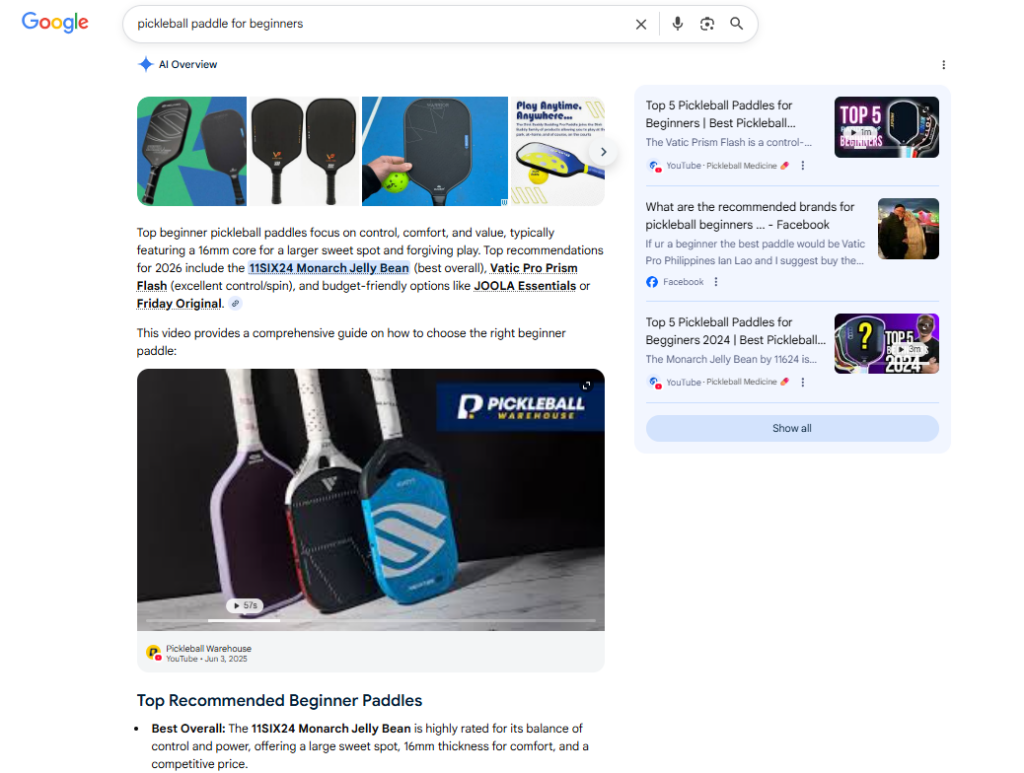
SGE creates a dynamic, multi-layered search experience for users. It synthesizes answers immediately while still giving access to original sources for those who want more detail.
A New Era of Search Optimization
Sixty-eight percent (68%) of organizations are now shifting their strategies in response to AI search. Over half of them are no longer doing SEO DIY but are leveraging marketing teams, like the best SEO agency Philippines, to lead their AI search optimization initiatives.
With AI search now coming to a profound stage of adoption, it is clear that optimizing for search is still as important as ever. Traditional SEO fundamentals should still be implemented: maintaining quality content, strengthening semantic relevance, and building brand authority. However, the scope is now broader. In order to secure maximum online visibility, brands must optimize not only for rankings but also for retrieval and citation within AI-driven search experiences.
Turn AI Search Optimization Into Your Next Growth Channel
AI search is not the future; it is happening now. The faster that brands become familiar and adopt new AI search optimization methods, the sooner they can gain visibility where users are actively seeking answers.
Do not let your competitors dominate AI search results. Start implementing AI search optimization today and secure your spot in the answers that matter most. Contact our team at Digital Marketing Philippines (DMP) today to make your brand AI-ready and future-proof.
References
https://neilpatel.com/blog/aeo-vs-geo-vs-llmo
https://searchengineland.com/guide/what-is-ai-seo
https://www.ibm.com/think/topics/large-language-models
https://www.forbes.com/councils/forbesbusinesscouncil/2024/07/15/gaio-the-next-generation-of-seo
https://www.coursera.org/articles/llm-vs-generative-ai https://about.ads.microsoft.com/content/dam/sites/msa-about/global/common/content-lib/pdf/from-discovery-to-influence-a-guide-to-aeo-and-geo.pdf

Jomer B. Gregorio is a well-rounded expert when it comes digital marketing. Jomer is also known as a semantic SEO evangelist and practitioner. Check out our Digital Marketing Services today and let us help you in achieving positive and profitable results for your business.