
As of early 2026, 37% of consumers report starting their searches with AI tools rather than traditional search engines. This aligns with a Gartner report suggesting that conventional search engine volume could drop by 25% by the end of 2026. With AI-native rivals like Perplexity and ChatGPT Search seeing a spike in queries, Google can no longer afford to be just a list of links.
To counter this shift and maintain its dominance, Google is aggressively integrating AI into search. In October 2024, Google announced that its AI Overviews feature had expanded to more than 200 countries and now reaches over 1 billion monthly users worldwide. More recently, the company has also begun leveraging AI in SEO platforms like the Search Console.
Google’s increasing investment in AI across both search and SEO platforms reflects a larger shift in how the company plans to maintain relevance in a rapidly evolving search landscape. In response, brands and marketers must also begin rethinking how they approach search visibility, authority, and content strategy.
The Growing AI Search Engine Competition
Google’s aggressive integration of AI into its SEO platforms is a direct response to a rapidly fragmenting search market. For the first time since 2015, Google’s global search market share dipped below the 90% threshold at the end of 2024. This change is largely driven by the fast rise of AI-native search platforms that are reshaping how people find and consume information online.

Image from Statcounter
Among these platforms, Perplexity AI saw its query volume triple to 780 million monthly queries in mid-2025. Simultaneously, ChatGPT has become a massive search destination in its own right, reaching over 900 million weekly active users and capturing an estimated 73% share of the total AI search market as of early 2026. This competitive pressure has forced Google to leverage AI not just as a feature, but as a defensive strategy to prevent a mass migration of its users.
It is the reason why Google is pivoting its SEO platforms to prioritize AI Overviews: to ensure that users get direct answers without leaving the Google ecosystem. But Google isn’t just changing the front end of search; it’s overhauling the back end as well.
With the addition of AI features in SEO platforms, Google is giving marketers the same advanced reasoning power it uses to analyze and interpret search data. The new feature helps turn a complex data dashboard into an AI-powered configuration tool.
How is Google Leveraging AI
Google has been leveraging AI in SEO platforms for years. In 2015, the company introduced RankBrain into its core algorithm, marking its first major transition into machine learning. RankBrain effectively turned the search process from exact keyword matching to interpreting human intent and identifying entity-based search authority. This change allowed Google to better understand the meaning rather than relying purely on text matching. Meanwhile, the launch of BERT in 2019 further advanced this capability by improving how the algorithm processes language context within search queries.
These developments laid the foundation for a much broader AI transformation in Search today. Currently, Google is embedding generative AI across multiple layers of its search experience and SEO platforms. Not only does it improve results relevance for users, but it also reshapes the future of SEO.
AI Overviews
AI Overviews are summaries that answer queries directly within the search results using information drawn from multiple sources. Google officially introduced AI Overviews in 2024 and has since expanded to become a key part of search engine results pages (SERPs) in over 200 countries and territories, and now appears across a significant portion of search results. About 30% of keywords now trigger AI Overviews in the US alone.
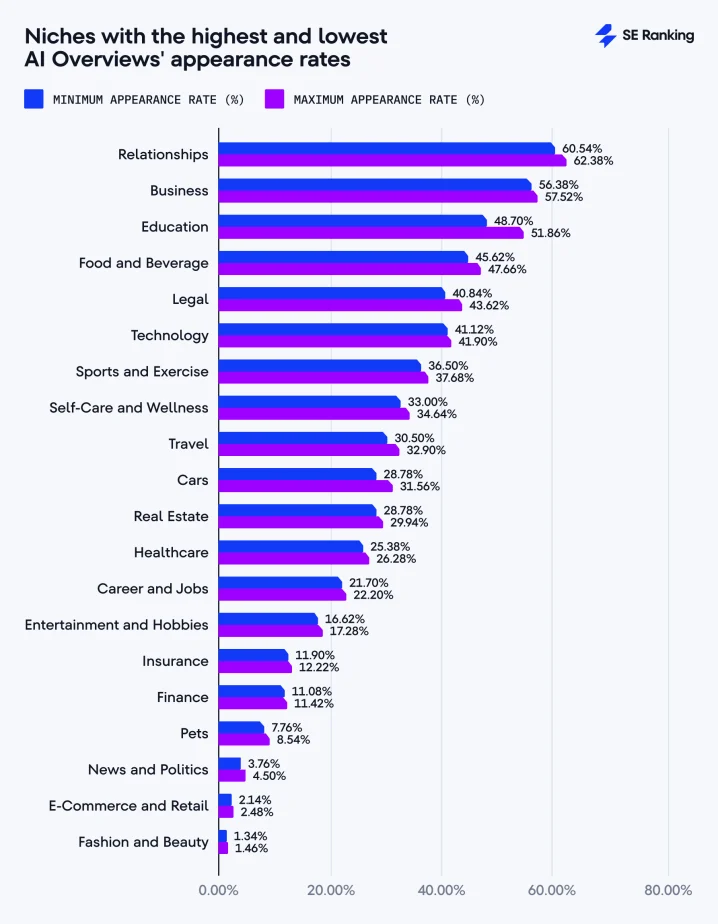
Image from SE Ranking
AI Overviews uses retrieval augmented generation (RAG), powered by Google’s own LLM, Gemini, to actively collect and synthesize fresh information from across the web and not just rely on its pre-existing knowledge. While AI Overviews are leading to more zero-click search synthesis for simple factual queries, it simultaneously offers a high-authority referral for complex topics.
The Overviews provide direct links to the sources used to build the answers. If users want to explore more on the topic, they can navigate to the cited websites for deeper information and context. For the best SEO agency Philippines, this can be a great alternative source of brand visibility and web traffic through generative engine optimization (GEO).
In fact, industry experts have observed that AI traffic is 4.4 times more valuable than an average organic visitor. This is supported by a substantial increase in engagement (12%), time-on-site (48%), pages per visit (13%), and conversion (42%) in websites cited in AI search engines.
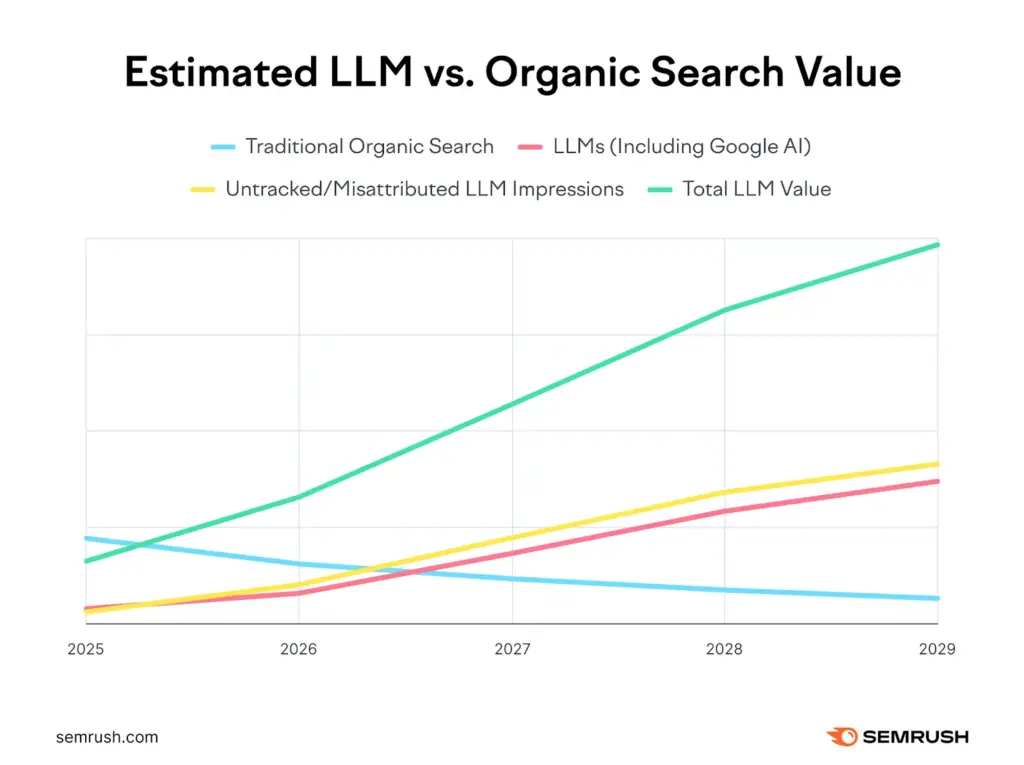
Image from Semrush
AI-Powered Configuration in Search Console
In February 2026, Google started to globally roll out its AI-powered configuration feature in the Search Console. This tool leverages Google’s LLMs to translate natural language prompts directly into technical report settings. So instead of manually navigating through multiple dropdown menus to apply filters, AI in SEO platforms enables users to type queries like “Compare mobile and desktop CTR” and receive a fully configured report in roughly 3 to 4 seconds.
The feature is currently limited to the Search Results Performance Report and does not yet support other critical sections like Discover or News. Nevertheless, this update now allows teams to quickly test hypotheses about site performance without the technical friction of manual reporting.
Tracking Performance Using AI in SEO Platforms
AI Overviews are changing the very metrics SEO platforms are built to track. For over two decades, SEO platforms were built on a simple link + click economy. AI Overviews have effectively broken that model by satisfying user intent directly within the search results page. Because of this change, Google also had to give marketers a tool—AI in SEO platforms—to help them better understand this new metric for visibility.
Google does not currently offer a dedicated tool or specific filter within its platforms to isolate citation count within AI Overviews. For example, in the Search Console Performance report, the numbers for a specific keyword are the combined values for traditional blue link clicks and clicks from the link cards inside an AI Overview.
Without the capability to distinguish the source of traffic and engagement, it is very challenging to determine whether a drop in clicks is due to poor ranking or the success of being cited as a source in AI searches.
Because of the lack of a native Google tool, the industry has turned to a combination of manual workarounds to track visibility in AI citations. One way is to look for informational queries where the impressions are stable, but their click-through rates (CTR) are comparatively lower, suggesting presence within AI summaries.
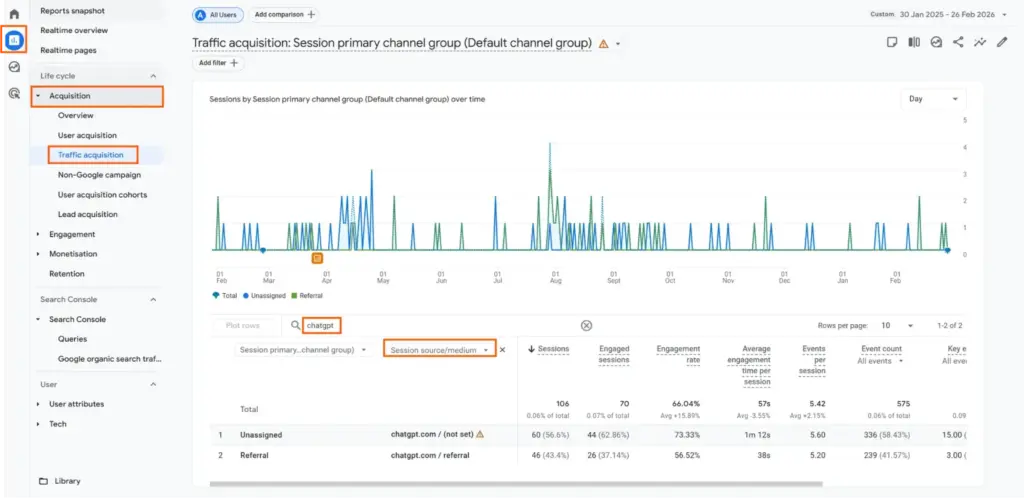
Image from HubSpot
Identifying these patterns manually can be a grueling process of spreadsheet analysis. However, with AI in SEO platforms, a marketing agency Philippines can uncover these insights instantly. Marketers no longer have to click through endless filters. Instead, they can use the platform’s advanced reasoning to surface these high-impression, low-click anomalies through simple natural language prompts.
Future-Proof Your SEO Strategy With DMP
The integration of AI in SEO platforms and search itself marks the end of the keyword-only SEO. Starting this year, SEO success means being able to demonstrate adaptability in measuring performance and implementing data-driven strategies.
Let us help you navigate these complex shifts. At Digital Marketing Philippines (DMP), we provide the technical expertise needed to get a better understanding of your performance within this new search landscape. Whether you need to optimize for AI-driven summaries or build a solid SEO foundation, our team leverages best practice techniques to ensure your business achieves optimal visibility.
Explore our solutions and see how we can expand your digital visibility.
References
https://developers.google.com/search/docs/appearance/ai-features
https://developers.google.com/search/blog/2025/12/ai-powered-configuration
https://primotech.com/ai-powered-configuration-feature-rolled-out-in-google-search-console
https://searchengineland.com/multimodal-discovery-redefining-seo-456816
https://neilpatel.com/blog/ai-in-google-search-console-google-analytics

Jomer B. Gregorio is a well-rounded expert when it comes digital marketing. Jomer is also known as a semantic SEO evangelist and practitioner. Check out our Digital Marketing Services today and let us help you in achieving positive and profitable results for your business.